.png)
Future Ready Academia: ORCID, Digital Resources, Emerging Technologies, and Bibliometrics & Research Impact
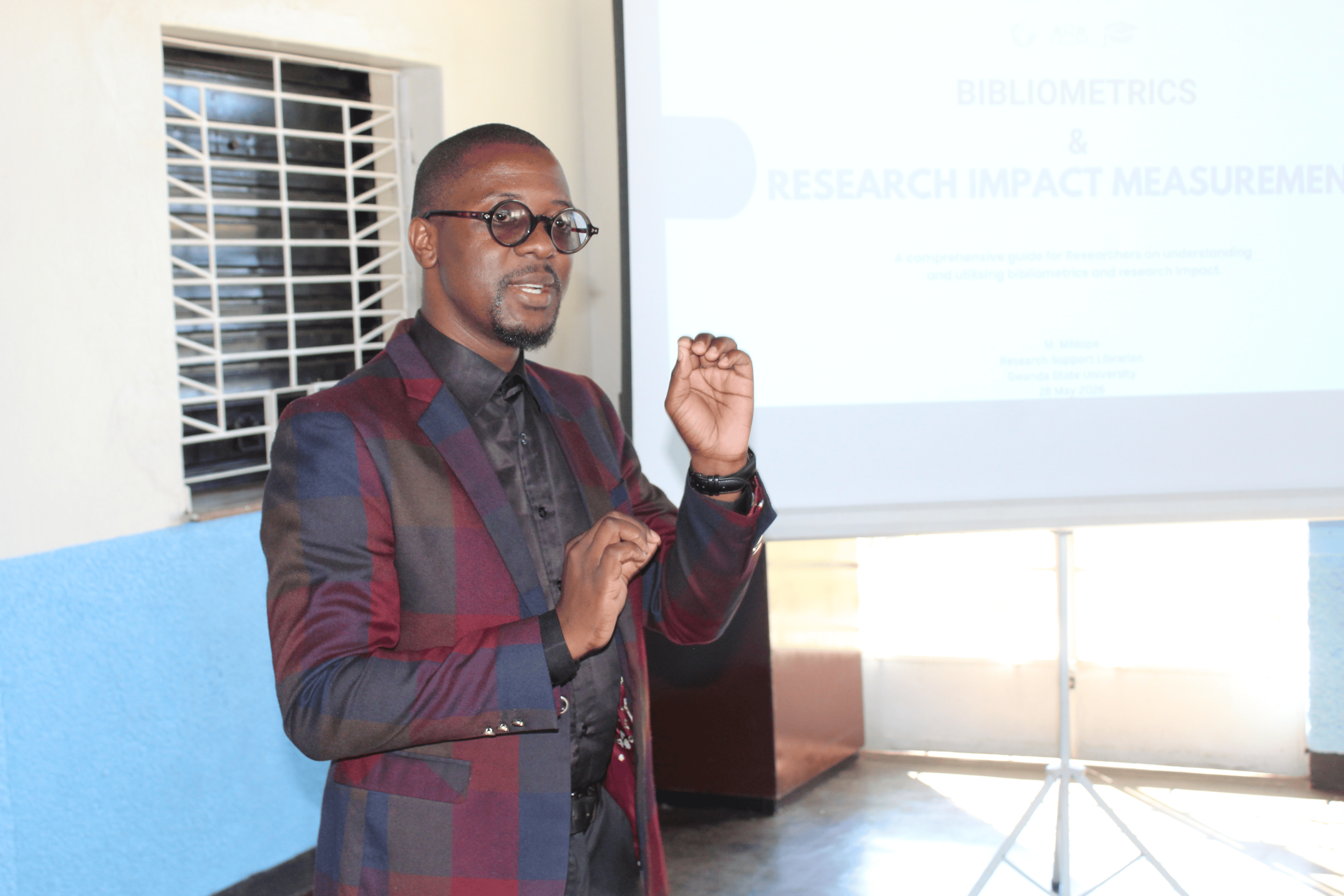
On the 28th of May 2026, the Gwanda State University (GSU) Library hosted an intensive, forward-focused workshop specifically designed for researchers, faculty members, and postgraduate academics. The workshop titled "Future Ready Academia: ORCID, Digital Resources, Emerging Technologies, and Bibliometrics & Research Impact" provided the academic community with practical tools to elevate their research visibility and navigate the evolving global publishing landscape. The workshop was divided into broad focus areas:
Securing Global Identity with ORCIDName ambiguity remains a major hurdle in academic publishing. Gwanda State University (GSU) has an active ORCID Community of Practice championed by the University Library and the Directorate of Research, Innovation, and Industrialisation. The initiative helps researchers, academics and Mphil students adopt persistent identifiers to improve the visibility, accurate attribution, and global tracking of their scholarly work. The workshop was a follow up session for a workshop that was held in October 2025. For researchers who did not attend the first session - learned how to create and manage their unique, permanent ORCID iDs. This digital identifier ensures that your work is never confused with another author's, automating publication tracking and guaranteeing proper attribution across international databases.
Maximising Advanced Digital ResourccesHigh-impact research requires high-quality data. The workshop deep-dived into GSU’s extensive digital repository, demonstrating how to fully leverage premium platforms like ProQuest Ebook Central, EBSCOhost, Britannica Academic and Springer Link to mention a few. Academics also mastered seamless, secure off-campus login protocols via OpenAthens, ensuring uninterrupted literature reviews from any location.
Harnessing Emerging AI and Tech ToolsThe modern researcher must work smarter, not harder. The library took attendees through cutting-edge discovery tools like Scite, a smart platform that categorises citations to show whether subsequent papers support, mention, or contrast a study's findings. The session also covered advanced reference management workflows to streamline citation generation and manuscript formatting.
Tracking Reach vai Bibliometrics & Research Impact(BRI)Understanding citation data is crucial for securing grants, gaining promotion, and proving institutional value. The library showcased its dedicated Bibliometric and Research Impact (BRI) Analysis Services. Through this service, academics learned how to identify top-tier, high-impact journals for manuscript submission, trace citation networks to uncover potential global collaborators and quantify and present their research impact to funding bodies.
For direct, one-on-one research support, contact our faculty librarians via WhatsApp at 0771433367 or email us at library@gsu.ac.zw
.png)